

NEMO II. © J.R.Lawes. 21/02/2026.
I thought I should try to write the story of Nemo II for the period I had first-hand knowledge of it.
When war broke out Nemo II was requisitioned by the Royal Navy, with Newt King, and used as a liberty boat/MFV in Brightlingsea. On the 11th. June 1940, Nore Command set up a stone fort (shore base) at 6, Regent St., Brightlingsea. This became HMS Nemo, named after the boat, allocated to them.
My father, being a retained fireman, then became a full-time fireman for the duration. After the war, Nemo II was returned to my father and Newt. This suggests that one, or probably both, were running Nemo II for some time prior to the war.
My father’s other business interests were building, in some of the winter months, as he was a master bricklayer. Some of his work is in the Clacton Baptist Church and Woods of Colchester, now Fläkt Woods. He was also the Lawes in Dowsett & Lawes, Coal Merchants. My uncle Harry ran the business and, on many occasions, I helped, loading cwt. (50.2kg) bags, sometimes directly out of the railway coal wagon but mainly at the Anchor Road coal yard and then delivering. Delivering was done with horse and cart, probably the last working horse and cart in Clacton. I well remember George and, later, Mary. I also helped, on occasions, with the grooming as well as driving the horse and cart around Clacton on deliveries. A few times I helped with hay making with Uncle Harry, who wielded a scythe, for the horse’s feed.
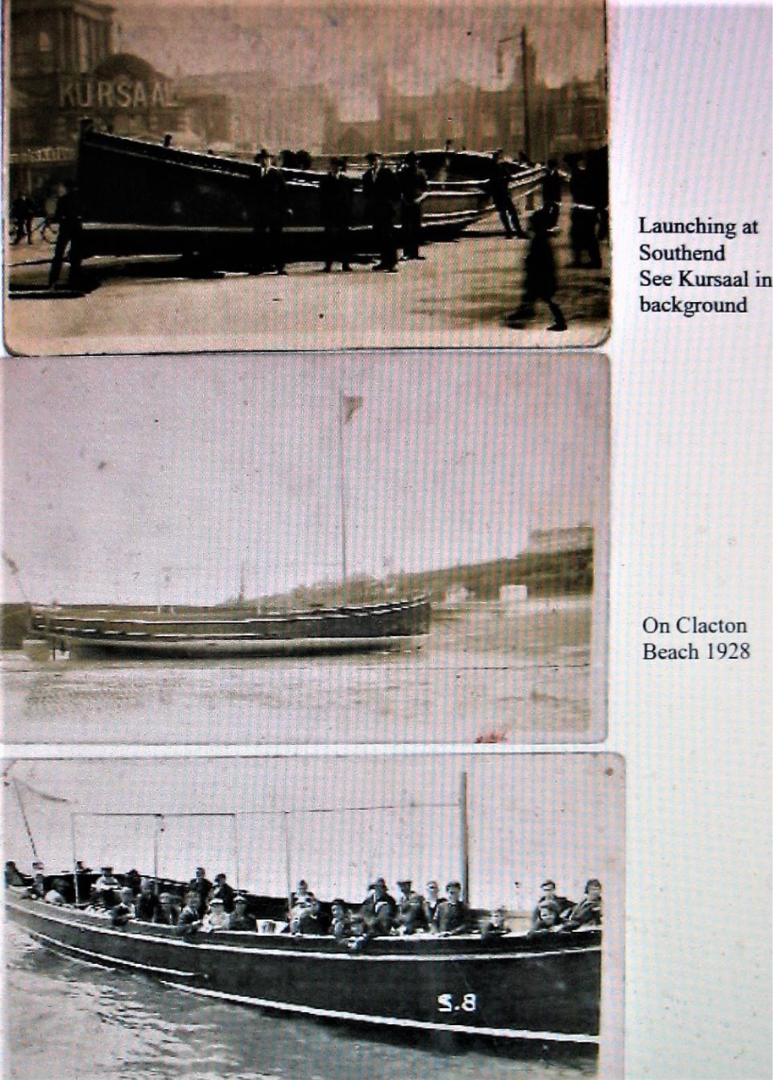
When the Nemo was returned, she was taken to James & Stone (Brightlingsea) Ltd. shipyard, now posh housing. It’s from here that I can go from personal memory. Nemo had acquired a ”superstructure”, for want of a better description. This was to give weather protection to “all those who sailed in her”. This was removed, returning her to her pre-war specification. This was, basically, a big carvel built “rowing boat”. I cannot remember, exactly, when she returned to working from the west beach, but this was probably 1946 or 47. I can certainly remember this work being carried out, as I often went with my father and Newt to “help”. Perhaps this sparked my interest in engineering, as I often wandered into the shipyards engineering workshops, usually coming out with some brass, or bronze swarf, to throw on the fire at home - it makes the flames go green.
Later the Nemo had its winter refit at Rowhedge Ironworks Ltd. (Rowhedge Shipyard), as the fees were more favourable. We would drive to Wivenhoe, park the car, Newt’s Morris 8, and take the ferry over the river. I well remember the shipyard had a really excellent works canteen, run by the workers wives on a non-profit basis. Excellent meals, very reasonable prices.
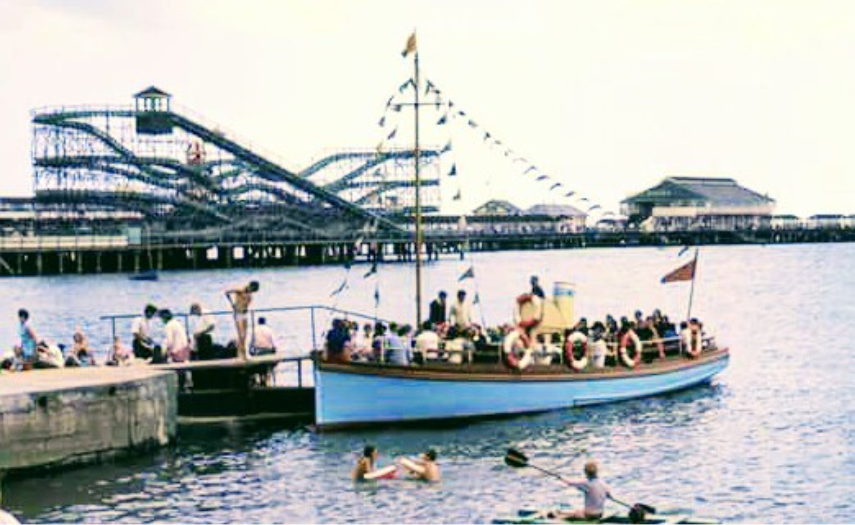
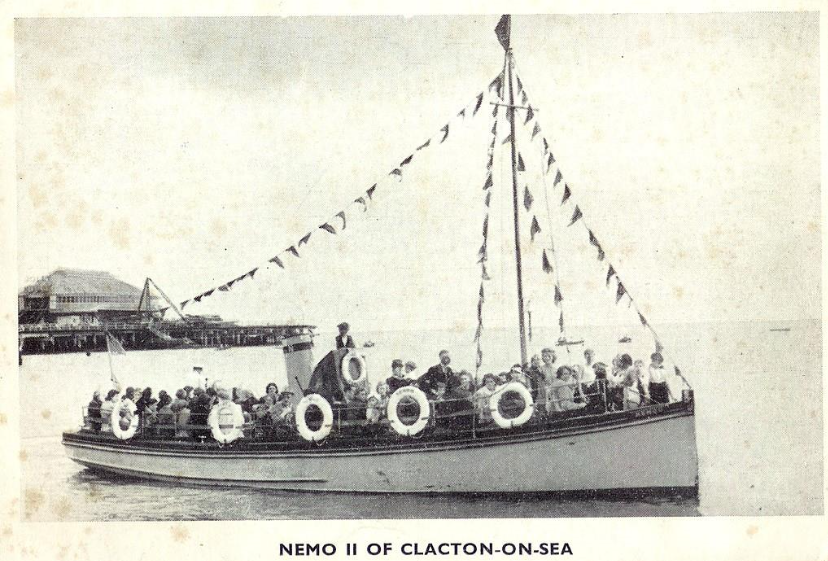
Around 1950, she was re-modelled with a proper engine room, with wheel and controls above, and with some weather protection. I remember we went to the Boat Show in London, where a new Thorneycroft diesel engine was ordered to replace the original petrol/paraffin (TVO) engine. In addition, the alterations involved a new deck, at thwart level, and seating around the gun’els’, with steel railings as a backrest, and, of course, for safety, as well as somewhere to mount lifebelts. Extra seating was placed in the centre, for’ard and aft. Aft had life rafts for seating, as well as for life saving. Now she was licensed to carry 82 passengers. She remained like this for the remaining time she was in my father’s and Newt’s possession, and certainly into the 60s. The later wheelhouse and fo’c’sle, “Viking Saga” style, being added after she passed to Dick Harman, who, previously, ran the Viking Saga.
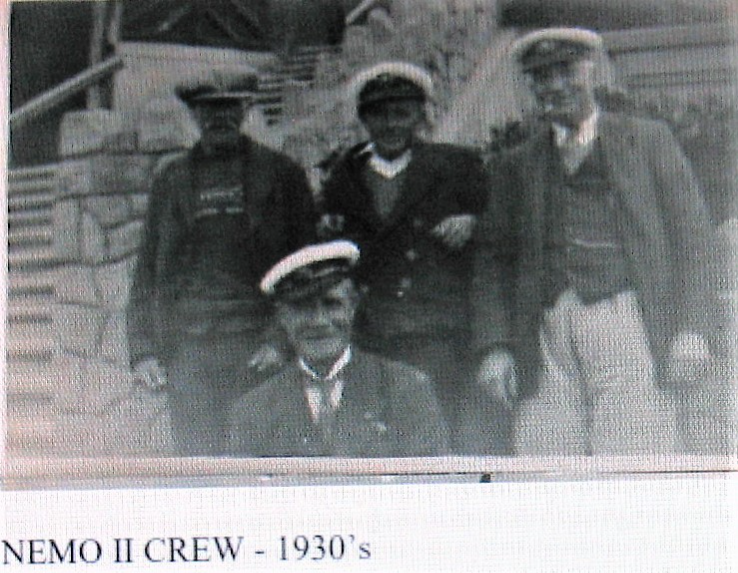
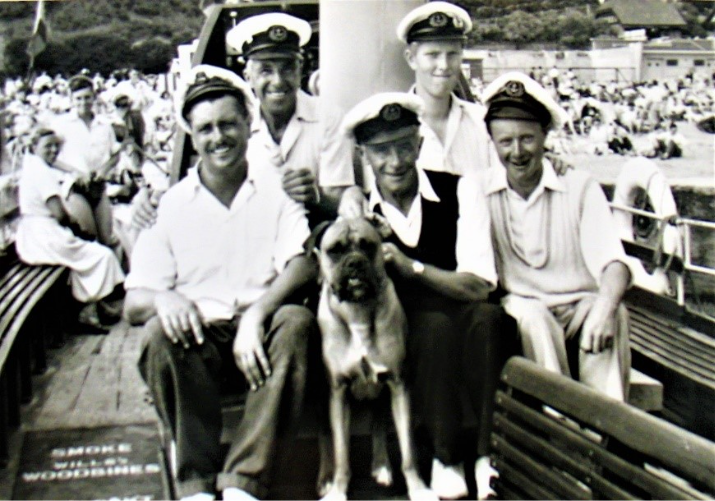
During the school holidays I worked, on the beach, with my father and Newt and other crew, making a total of four, plus me when available. Other duties included fetching my father’s lunch on my push bike. At times, I would take the wheel when on pleasure trips and also taking the “Nemo” to/from Brightlingsea and Rowhedge. Crew members, at various times, included Albert Potter, Sid Salmon, Dick Harman, Jack King and Billy Dale. The dog’s name in the photo I can’t remember, it belonged to a regular customer, and I am in this photo. Often, on trips, we would see a shrimper, when we would pull alongside for the trippers to purchase cooked shrimps, straight out of the pot. Usually, a few dog fish and skate were available, which we often purchased, all at very advantageous prices. This connection with the Nemo continued for some time after I left school, when I worked at weekends and holidays.
When 15, I became a licensed boatman, Clacton UDC No 21. I still have my hat with the Nemo II cap badge and licensed boatman badge. I never took the test, as the boat inspector was Albert Potter, who knew my capabilities very well. I also still have Nemo’s compass and the printing plate for the Nemo photograph, below, which appeared on printed posters.
My stepbrother Jerry has Nemo’s bell. In the photo, Newt is at the wheel and my father at the stern, just having taken in the stern anchor. Later, a much larger brow, mainly Dick Harman’s idea I believe, was introduced. This meant a more accurate approach, as previously the smaller brow could be manhandled into position, if necessary. A bow rope was then attached which, with the stern anchor, secured the Nemo in position. Further security being ensured by coming alongside the brow or breakwater, where the tide or wind, whichever was the stronger, help hold her in place. The larger brow did away with the need for a bow rope; a stern anchor being used only in poorer weather conditions. This was another improvement. By not normally needing the stern anchor, it saved my father’s back. At least once dad had to have time off due to sciatica.
I once “put to sea” on this brow; I happened to be on the brow when, for some reason, the ratchet on the winch had not been applied, or perhaps the wire rope was not attached. I don’t remember. The brow ran down the beach and into the drink. This was when the Nemo was being brought from its moorings. There I was, with the brow floating about ten inches (250mm) below the surface. No problem providing I kept in the centre. Shortly, the Nemo arrived, which saved me from a swim. Another job I usually got involved with was the cleaning of her bottom, mid-season. When the tide was right, Nemo would be beached early evening. A bit later with the tide ebbing, the growth on her underside was scraped off and a coat of anti-fouling applied. Happy days!
When the Nemo was sunk in 1956, (see photos), it was due to a storm coming up very quickly. Newt was the first to get down to the pier, but, due to the storm’s quickness and severity, no one could get to the Nemo to take her to safety.
Perhaps the quickness, and severity, of the storm was a blessing in disguise as I understand Newt couldn’t swim. In these situations, the Nemo would normally be taken round to Brightlingsea, but on the few occasions, when a severe wind was in the wrong direction, she would go to Harwich. While Nemo was “out of service”, we used rowing boats, with me working from the east beach. I took, mainly, children for “a row with the boatman”.
Running from the West Beach, in addition to Nemo, were the Viking Saga and Jill, the last time I saw her, she was at St. Osyth, looking rather forlorn. Then there were sister boats “Lady Essex” and “Lady Kent”. Running from the east beach for a while, was the “Skylark” with Jack King and a power boat, the name of which I can’t recall, run by Freddie Knight.
The very latest photos of the Nemo show that she came to very sad, and neglected, end. I would like to think I was involved, in a very small way, in her very best years.
I am keen on preserving our past but know we can’t keep everything. How she would fit into our modern world, I’m not sure. A “heritage boat trip” perhaps? A ½ hour for 2/6d (12.5p) children half price?
© J.R.Lawes. 21/02/2026.
 Print
Print 